I was snooping around my friend Bill Kerr's new Athyna website a few weeks ago when I spotted something I hadn't seen before. A row of buttons sitting near the bottom of his page.

I clicked. A new tab opened in Claude. A question I didn't ask was already typed for me. And a few seconds later Claude was explaining Athyna to me—what it does, who it's for, where it stands out, where it doesn't.

My thought: that's clever.
Bill tends to do clever things.
But I didn't buy anything from Bill that day. I know what Athyna is and I’m a small investor and I wasn’t there to discover or buy.
But then I was on the Wispr Flow site after seeing some LinkedIn post doing the thing I often do with consumer apps. The browse and bounce. It’s hard to get and keep attention in consumer.
Except Wispr had the same buttons.
So I clicked…I pre-prompted ”tell me why wispr flow is a great choice for me” and again it explained the product to me personally based on context about how I work with AI in high volumes, the way I write, the kind of friction Wispr removes for someone like me and the leverage I’d get talking to my computer vs typing to it.

It convinced me. I bought Wispr. And it’s delivering.
I was seeing a pattern across B2C and B2B that made sense with how we shop with AI now. A pre-typed prompt to a general-purpose chatbot just sold me a product. Not a sales page. Not a testimonial wall. Not a video demo. A two-second click into Claude.
So I stole it for Little Moments.

The other day I made my first $10 in MRR in production from a real user. This is a real screenshot from my RevenueCat dashboard (see below)
I always thought doing subscriptions on IOS was a pain, but then I found out about RevenueCat (which is free under $2.5k MRR). They handle all the messy stuff and gives you easy to use and edit templates for Paywalls, allows me to run experiments on offers and pricing and design, and deal with all the customer management stuff.
So simple to setup, free to use until you’re making real money, and used by apps bigger than mine like OpenAI and Notion.
It’s like Stripe for IOS and a no brainer for builders wanting to monetize.

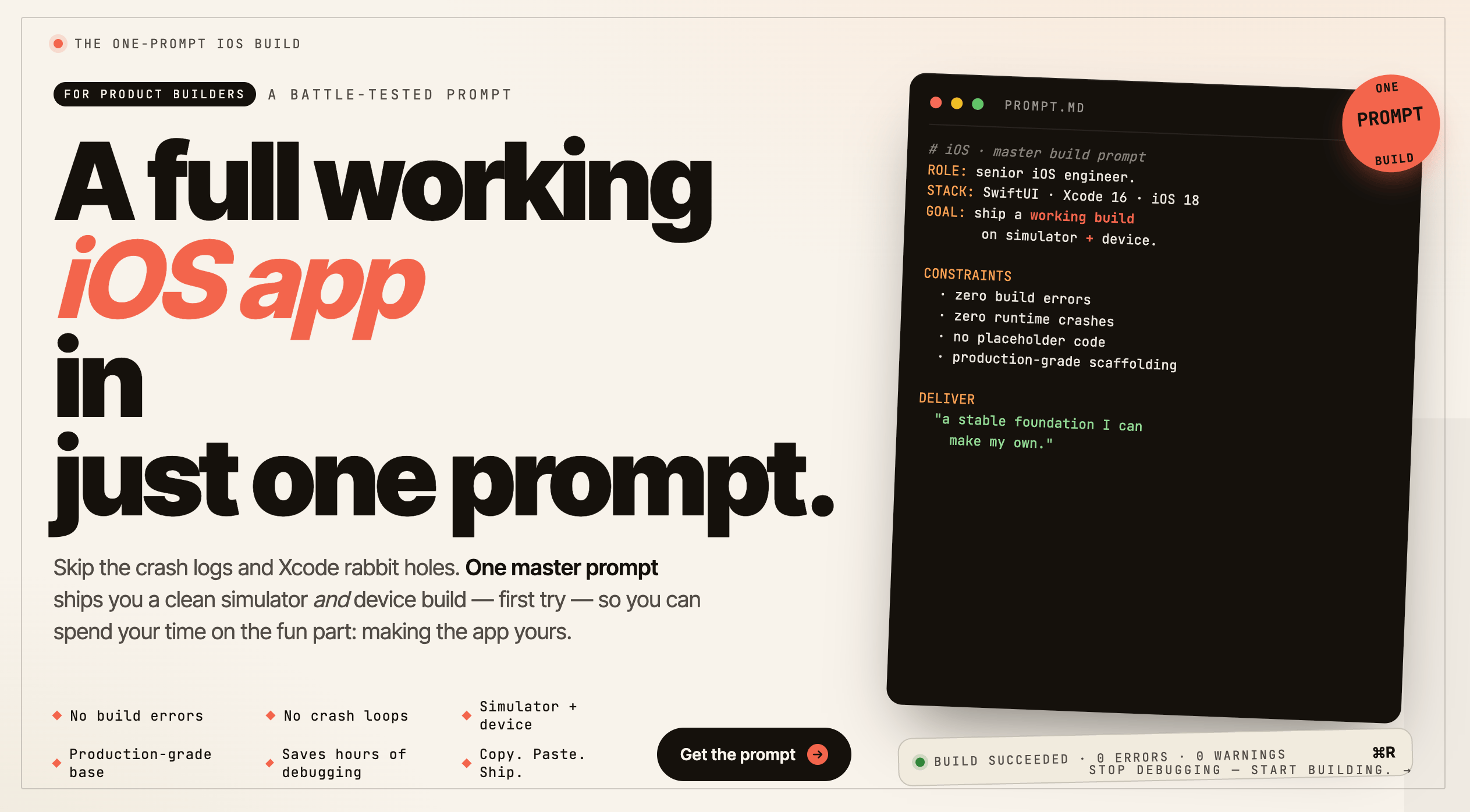
Thank you for supporting our awesome sponsors, who keep this newsletter free.
Why this tactic actually works
The reason is simple: it’s who's doing the talking.
When I tell you Little Moments is great, I'm a salesperson. Of course I think it's great. I built it. If a third-party site links to me with a "5-stars review" badge, that's a salesperson too — they got paid in some way or they wouldn't be linking. Banner ads, testimonials, even product reviewers I trust—they all sit somewhere on the spectrum of someone has skin in this.
But when an AI model your buyer already trusts and uses every day explains your product, it doesn't feel like a pitch. It feels like a second opinion. And second opinions are the most persuasive type of opinion that exists.
Fun fact: Webflow has seen a 6x conversion rate from LLM traffic vs Google search traffic. That's not a marginal lift, that's a different sales motion altogether.
People who arrive at your site after asking an AI about you have already been pre-sold by an intermediary they trust. They're qualified before they get to you. This isn’t that because you’re funneling people back to AI and off your site…which comes with risks. But if people didn’t come from AI search, the bet here is sending them there to get the LLM working for you increases your conversion with them. Which is often why these components are at the bottom of the site—if the person is here they are probably not convinced yet, so let AI do it.
That's the emerging move here. You stop the sell. You let the AI explain you, and the buyer believes the AI more than they'd ever believe you.
Each button is just a hyperlink. Easy peasy lemon squeezy. No API call, no integration, no SDK. Nadda. You're just opening up the chatbot's website with a question already typed in.
Each AI accepts a prompt via URL parameter:
ChatGPT:
https://chat.openai.com/?q=...Claude:
https://claude.ai/new?q=...Perplexity:
https://www.perplexity.ai/?q=...
Whatever you put after q= (URL-encoded) becomes the pre-typed prompt. Click the button, the AI's site opens, your question is already there, and the model starts answering.
You can ship this literally right now. I did it in under 5 minutes. Three buttons, three pre-built links, paste into the landing page footer, deploy. Done.
You can see it here: www.getlittlemoments.com

the link is exactly this

https://claude.ai/new?q=How%20would%20the%202%20minute%20daily%20journal%20app%20getlittlemoments.com%20help%20me%2C%20and%20why%20should%20I%20specifically%20give%20it%20a%20try%20vs%20other%20journal%20apps%20or%20practices%3F
But I had to do something different to Wispr and to Athyna because LLMs don’t know my little unknown app…
My first prompt was bad
When I first tried it in testing, I did what Bill did and kept the prompt very tight. Something like "What is Little Moments and is it worth using?".
But Claude responded with a paragraph about how journaling is a good practice etc but said nothing about my app.
It hadn't heard of Little Moments. Of course it hadn't but that didn't stop it from confidently riffing about it. Click that as a user and you'd assume the founder doesn't know what they built which is worse than no button.
The key here if you have a unknown product is to add the URL so models with web access can fetch the actual page. Also, I added a one-line neutral descriptor so the model had some spoon-fed context to anchor to, and added a nudge so the answer felt personal instead of generic. This ended on an honest, open question — not "is this great?" but something a real person would actually type.
How would the 2 minute daily journal app getlittlemoments.com help me, and why should I specifically give it a try vs other journal apps or practices?The new version convinces me the way the Wispr one did The AI talks about Little Moments specifically. Mentions the voice capture (it remembered I liked voice from Wispr), the 2 minute constraint (because I am busy), the daily prompt mechanic (because I have abandoned open journals before), why it’s good for me. Reads like a friend who actually checked out the app and texted me back.
To sanity check what the AI knows about your product, open an Incognito chat and ask it “tell me why <your product name> is a great choice for me” . You need to do Incognito so there isn’t memory of your app which I’m sure you AI would have from all your conversations about it.
In my opinion, and I’m not doing it perfectly and neither is Bill or Wispr, I think the ideal prompt bakes in an honest question: Would this work for me? Be honest about the weak spots too."
The goal is a non-salesy opinion. That’s landing spot #1 for an answer.
The persuasion comes from the answer being balanced, not glowing. A response that says "great for X, less ideal for Y" converts better than one that says "amazing in every way" . The user trusts it. Honesty is the trick. Don't try to bias the model. Let it speak fairly because the fairness is the marketing.
But is it sending people to a black box?
The question is does it work. The 6X conversion stat from Webflow isn’t exactly the same thing.
So far I’ve had 17 clicks. That’s simple to track and is a top of funnel signal. The problem with this is real measurement.
Attribution is genuinely tricky because the user leaves your site and whatever happens next is invisible to you.
I messaged Bill asking for some info incase he’s figured it out but he hasn’t replied yet (we take a long time to get back to each other)

I’ve shared Little Moments in a few spots but there isn’t a clear picture of how we go from “Ask AI” to download to say how many signed up because of this thing.
I was thinking I could try add UTM parameters in the prompt URL.
i.e append a UTM-tagged URL to the prompt itself: " getlittlemoments.com?utm_source=chatgpt&utm_medium=ai_referral&utm_campaign=ask_ai_button". If the AI's answer includes the link (which it likely especially with browsing-enabled models), and the user clicks through from the AI's response back to your site, that visit is now attributable and we’re one step closer to turning a black-box detour into a measurable loop:
landing page → click button → AI answers → user clicks AI's link → back to your site, tagged
This would the closest thing to real attribution I think you can get but it’s messy. You have to include that in your prompt and that starts looking suspect even if it’s not.
Not so nice and doesn’t feel like that second opinion as much we’re after.

We could do some indirect signals though
Conversion lift A/B test. Put the Ask AI section on the page for half your traffic, hide it for the other half, measure signup rate. This tells you the true impact, not just engagement. Run it for a few weeks at decent volume if you have it.
Self-reported attribution. Onboarding survey: "How did you hear about us?" with "AI assistant (ChatGPT, Claude, etc.)" as an option. Noisy because that might not be how they hear about you, but directional.
I don’t think you can get a clean last-click attribution here, because users might see the AI answer, close the tab, and come back to sign up days later via a different channel. The Ask AI feature's real value is in trust-building. As a conversion assist, not a conversion source. So I’d say don’t judge it on direct attribution alone. Judge it on: click rate, lift in overall signup conversion when the section is present, and qualitative signals like survey mentions.
Any other ideas from anyone? I’m not a marketer 😂
Either way, unclear attribution aside, go try it on something. It's the cheapest piece of marketing infrastructure I've ever deployed.
If you haven’t yet, give the app a try: www.getlittlemoments.com
Chat soon.
—Jaryd (view my stack of non-negotiable building tools here)
This post was kept free thanks to our partner, RevenueCat — the no brainer for builders who want to make money with an app. Learn more about them here.
Thank you for supporting our awesome sponsors, who keep this newsletter free.